
A few days ago, I came across a discussion where a SaaS founder asked:
“What’s the best pricing model for my product?”
The replies came instantly.
People discussed:
- Freemium vs subscription
- Pricing psychology
- Tier structures
- Anchoring
- Decoy pricing
- Conversion tricks
You know the usual conversation.
But almost nobody asked something much more important first:
“What does it actually cost you to serve one customer?”
And honestly…
That’s the question that decides whether growth feels exciting or exhausting.
Many SaaS Founders Think About Pricing Way Before Understanding Their Costs
This happens all the time.
Founders spend weeks thinking about:
- What pricing model to use
- Whether they should charge monthly or yearly
- Which number “feels premium”
- How to increase conversions
But very little time is spent understanding:
- What one customer truly costs
- Which clients are profitable
- Which activities drain time and energy
- Whether growth improves the business… or slowly breaks it
And that creates a harmful situation:
The business can look successful from the outside while quietly becoming harder to run internally.
Pricing Models, Pricing Psychology, And Costing Are Not The Same Thing
These three ideas get mixed together constantly.
But they solve completely different problems.
Pricing Models Are All About…
How you collect money.
Subscription.
Freemium.
One-time payment.
Retainers.
Usage-based pricing.
And so on…
Pricing Psychology Is…
How customers emotionally perceive your pricing.
Anchoring.
Charm pricing.
Tiering.
Urgency.
Decoys.
And, Costing Means…
What it actually takes to deliver your product or service profitably.
Not just money.
Also:
- Time
- Support effort
- Revisions
- Operations
- Delivery complexity
- Infrastructure
- Founder attention (yes, this matters too)
Pricing models affect the revenue flow.
Pricing psychology affects the conversions.
But costing affects whether success feels sustainable. (think about this for a moment). Because this is the part many founders discover too late.
The Invisible Problem Many SaaS Founders Are Not Talking About
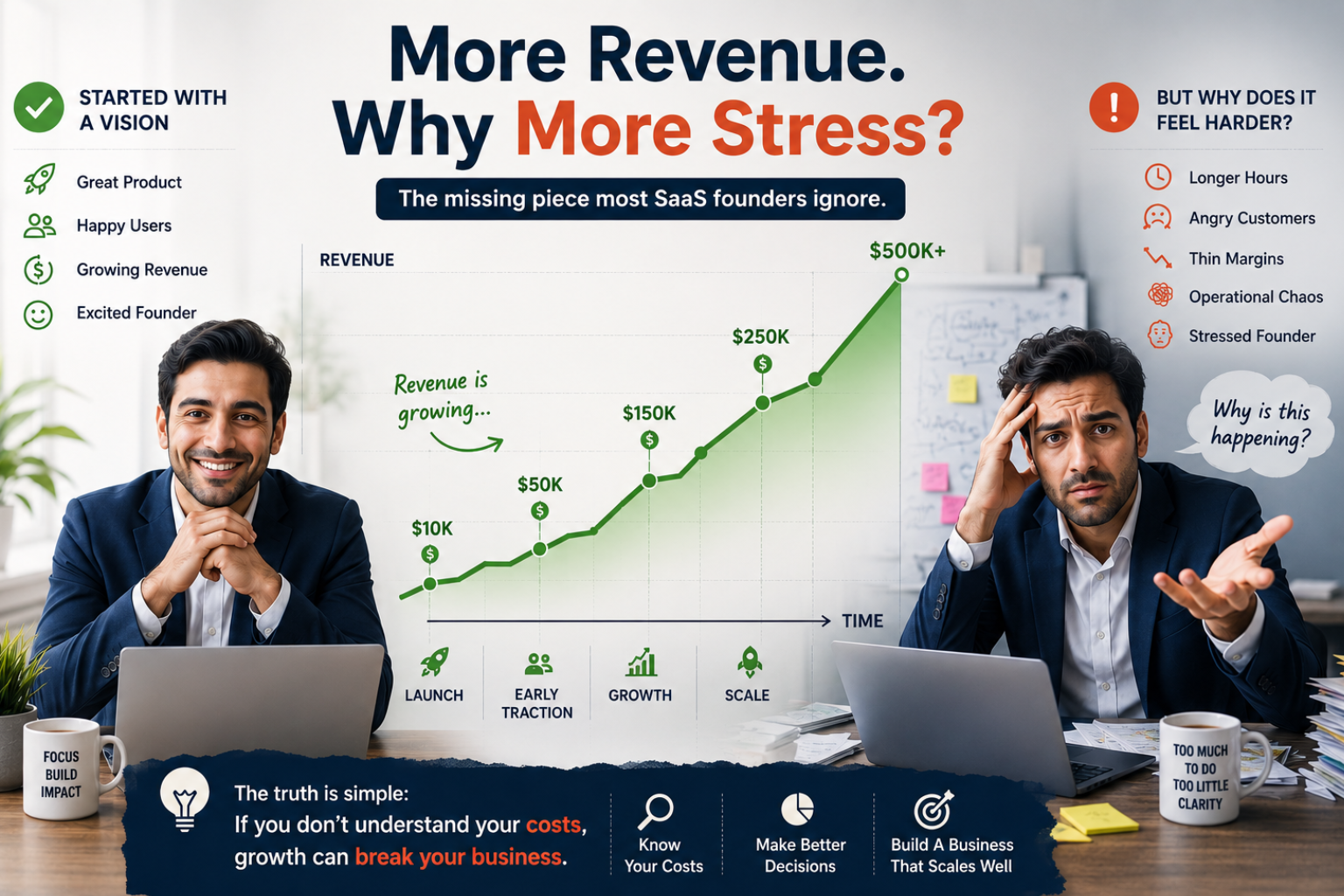
Here’s a situation many SaaS founders quietly experience:
Revenue is growing.
Clients are coming in.
Sales pages are converting.
But somehow:
- Cash still feels tight
- Work feels heavier
- Support becomes overwhelming
- Every new customer creates more pressure
- Growth increases stress instead of freedom
And when this happens, the advice founders usually receive is predictable:
- Raise prices
- Add urgency
- Change the offer
- Launch another campaign
- Add more features
- Create another tier
All of that sounds productive.
But none of it answers the deeper question:
“Does each sale actually make the business healthier?”
Because if the answer is unclear…
Growth can quietly multiply inefficiency instead of solving it.
This Is Why Some SaaS Startups Stay Stuck For Years
Not because the founders are lazy.
Not because the offer is bad.
But because the economics underneath the business were never fully understood.
And when that happens:
- Discounts feel harmless
- High-ticket clients become emotionally exhausting
- Scaling increases operational chaos
- More revenue requires disproportionately more effort
- Profit becomes unpredictable
- Founders start undercharging out of uncertainty
Eventually the business starts feeling “heavy”.
That heaviness is often a costing problem disguised as a motivation problem.
“Sales Is Vanity, Profit Is Sanity, But Cash Is Reality”
You’ve probably heard this famous old quote before.
It’s relevant even today because it’s painfully true.
A business can have:
- High revenue
- Lots of customers
- Strong engagement
…and still struggle financially.
Because sales volume alone does not guarantee healthy economics.
If margins are weak, delivery is inefficient, or support costs are uncontrolled…
growth can actually make the business harder to operate.
That’s why understanding your costs matters — even for solo founders, creators, agencies, coaches, consultants, and SaaS startups.
Not just CFOs.
Costing Is Not Just “Accounting”
This is where many founders disconnect from the topic.
The word “costing” sounds technical.
Corporate.
Finance-heavy.
Spreadsheet-only.
But in reality, costing is simply understanding:
- Where your time is going
- Which work creates profit
- Which clients drain resources
- What delivery actually requires
- Which activities scale well
- Which ones quietly burn you out
That clarity changes how you make decisions.
Because once you understand the economics underneath your business…
you stop guessing.
What Changes When Your Costs Become Clear?
A lot more than people expect.
You start:
- Pricing with confidence instead of fear
- Understanding which clients are worth pursuing
- Knowing which services are actually profitable
- Making decisions faster
- Identifying operational waste early
- Feeling less resentment toward your work
- Predicting growth more realistically
Most importantly:
Your business starts feeling lighter instead of heavier.
The Real Question Most Founders Should Ask
Before obsessing over pricing models, conversion tricks, and growth hacks…
Ask something simpler:
“If this business doubles next year… does my life improve or become more stressful?”
That question reveals more about business health than most pricing discussions ever will.
Because sustainable businesses are not built only on revenue.
They’re built on clarity.
P.S. This is exactly the kind of work I help SaaS startups with, so scaling feels more sustainable instead of more chaotic.
If you are interested in discussing more, feel free to contact us or directly email me at: abhishek@lucidova.com
Leave a Reply